Introduction of a Simplified Bankruptcy Procedure for Small and Micro-Enterprises: Roundtable Discussion on Draft Law No. 15024
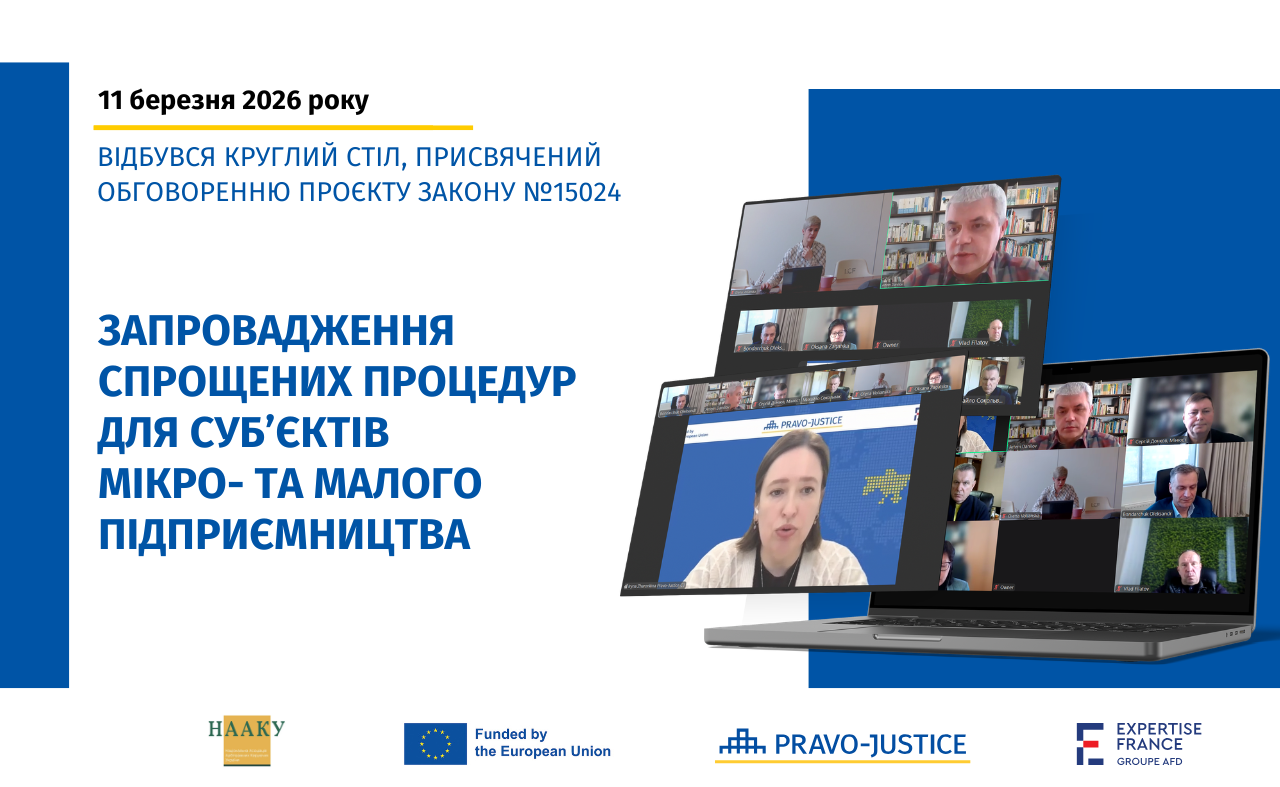
On 11 March, the Ukrainian National Insolvency Trustees Association and EU Project Pravo-Justice convened an online roundtable discussion entitled ‘Simplified Bankruptcy for Small and Micro-Enterprises: The Structure of Draft Law No. 15024’. Representatives of the Ministry of Justice of Ukraine, the Supreme Court, commercial court judges, bankruptcy trustees, and representatives of the banking sector took part in the discussion. The event aimed to discuss Draft Law No. 15024 and develop joint approaches to the introduction of simplified bankruptcy procedures for micro and small businesses. The participants exchanged views on how to make these procedures accessible, efficient and balanced, taking into account the interests of both debtors and creditors.
Iryna Zharonkina, Enforcement and Protection of Property Rights Component Lead at EU Project Pravo-Justice, noted that the Project analysed the Draft Law for compliance with the conditions of the Ukraine Facility Plan. These conditions relate to the accessibility of the procedure for micro, small and medium-sized enterprises and private entrepreneurs, access to the services of insolvency practitioners, and the prevention of abuse of the procedure.
“Micro and small businesses account for the largest share of undertakings, yet they are the most vulnerable to financial risks. This is why it is necessary to introduce simplified bankruptcy procedures for such companies in order to ensure a swift and predictable phase-out from the market or effective debt restructuring,” said Iryna Zharonkina.
Yulian Khorunzhyi, senior partner at Ario Law Firm and a member of the working group that developed the Draft Law in question, presented the concept behind the legislative initiative.
“The Draft Law aims to create a more humane and effective bankruptcy system, which gives entrepreneurs the opportunity to start a business again after becoming insolvent, makes the procedures faster and more accessible for small businesses, and at the same time ensures adequate protection for creditors against potential abuse,” said Yulian Khorunzhyi.
According to him, Draft Law No. 15024 envisages introducing a mechanism to release private entrepreneurs from the majority of their debts if insolvency proceedings last more than three years. This is intended to give entrepreneurs a ‘second chance’ after they have made a bona fide attempt to settle their debts. The document also introduces a simplified insolvency procedure for micro and small enterprises with short review periods – approximately up to six months – and simplified procedural stages. At the same time, the application of such a procedure will only be possible in relatively straightforward cases without property disputes. The Draft Law also introduces the criterion of the debtor’s good faith as a condition for using simplified procedures and provides for the mandatory involvement of a bankruptcy trustee with a limited mandate. The document also simplifies the application of the preventive restructuring procedure for small businesses.
Artem Danilov, Chair of the Committee on Research and Development and Professional Expertise of the UNITA, presented the position of the professional community of bankruptcy trustees on Draft Law No. 15024.
“The professional community supports the very idea of adjusting bankruptcy procedures to the needs of small businesses. At the same time, it is important that such a model ensures both efficient procedures and an adequate level of legal protection, so that it can serve as an effective and balanced tool without creating additional legal risks. We hope that the comments we have made will be taken into account during the further elaboration of the Draft Law,” said Artem Danilov.
Serhii Donkov, Director of the Bankruptcy Department at the Ministry of Justice of Ukraine outlined the regulator’s position and emphasised the need for all stakeholders to conduct a thorough analysis of the new bankruptcy procedures. In his opinion, such an analysis is necessary to ensure that the draft legislation takes into account the potential risks and shortcomings of the proposed changes to the concept of bankruptcy in Ukraine.
“The Draft Law on simplified procedures should be adopted in such a way as not to undermine the legal framework of the competition process that has already been developed. We must be careful not to undermine things that are already working effectively when introducing new tools,” stressed Serhii Donkov.
Oleh Vaskovskyi, Supreme Court justice and Secretary of the Judicial Chamber for Bankruptcy Cases at the Commercial Court of Cassation within the Supreme Court, emphasised how important it is to take a particularly measured approach to regulating bankruptcy proceedings, particularly at the stage of commencing proceedings, as it is this stage that largely determines the subsequent progress of the entire case.
“The rules governing initiation of bankruptcy proceedings must be clearly defined in legislation, and not shaped by subsequent judicial interpretation. An excessive number of discretionary or open-ended legal constructs complicates the application of the law and may lead to differing approaches in practice,” said Oleh Vaskovskyi.
He also expressed doubts as to whether all the key stages of the procedure could be carried out effectively within such a tight timeframe, as this might not reflect actual economic processes and could hinder the achievement of the intended outcomes.
The participants agreed that the Draft Law requires further revision before it is considered by the Verkhovna Rada in the second reading. To this end, it is important to establish a working group that brings together all key stakeholders in order to agree on amendments within a short timeframe. It is precisely this joint effort that will make simplified procedures an effective tool for supporting small businesses and economic recovery.