EU Project Pravo-Justice Supported the Research on Judicial Oversight in Enforcement Proceedings, Which Has Now Been Completed and Presented
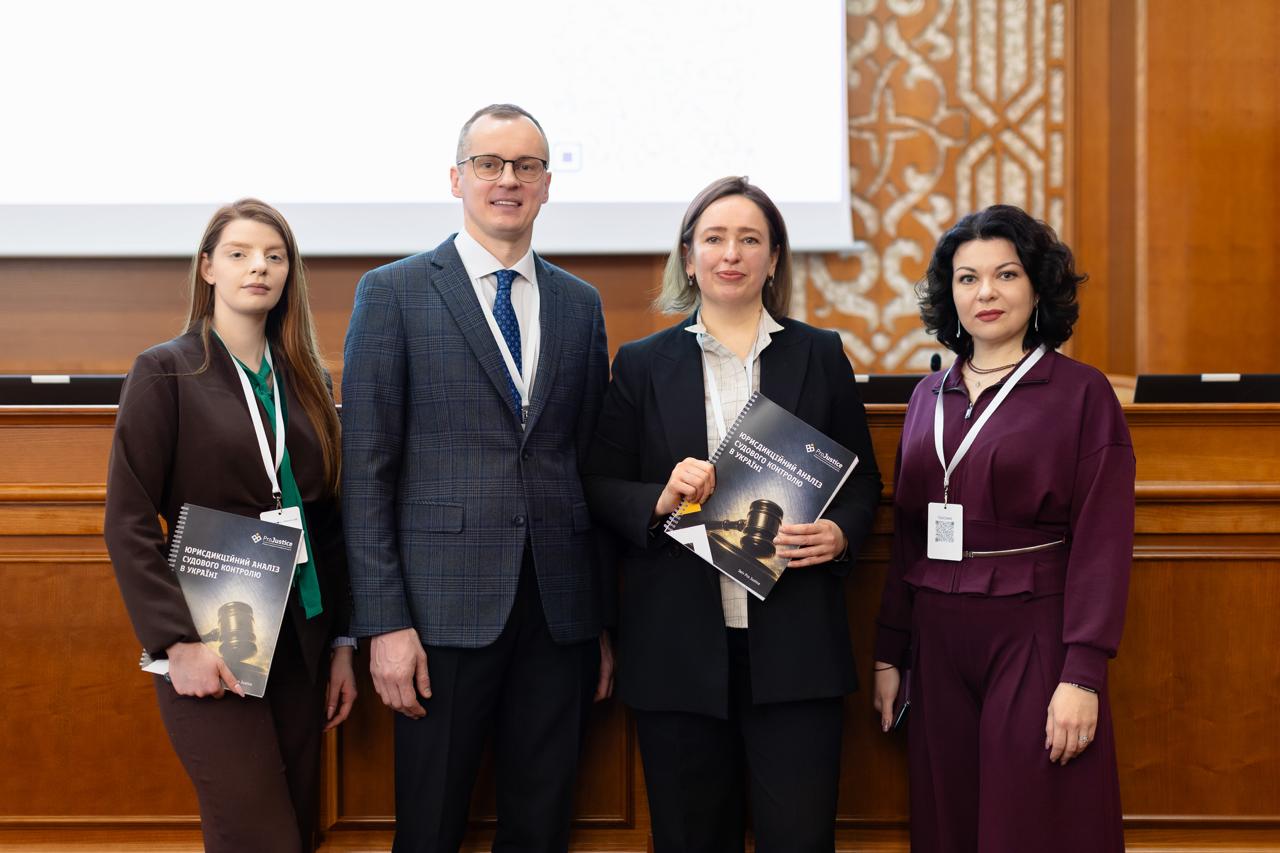
On 9 March, the NGO Interregional Expert Centre PRO JUSTICE presented the findings of its research ‘Jurisdictional Analysis of Judicial Oversight in Ukraine’, conducted with the support of EU Project Pravo-Justice. The report focuses on the functioning of the judicial oversight procedure regarding the enforcement of court decisions, in particular such an important tool as the enforcement report.
Judges, in particular the Supreme Court justices, members of the High Council of Justice, representatives of the State Judicial Administration, private enforcement officers, scholars and experts from EU Project Pravo-Justice participated in the discussion of the research findings.

Iryna Zharonkina, Enforcement and Protection of Property Rights Component Lead at EU Project Pravo-Justice, highlighted the scale of the problem of enforcing court decisions in Ukraine and, consequently, the importance of further developing the institution of judicial oversight.
“According to the data provided by the Ministry of Justice of Ukraine, the total amount of arrears arising from court decisions currently pending enforcement before the State Enforcement Service and private enforcement officers exceeds UAH 1 trillion. In social and pension cases alone, the arrears amount to UAH 85 billion. This represents around 700,000 unenforced decisions. Therefore, the problem of non-enforcement and the protracted enforcement of court decisions not only has a quantitative and temporal dimension, but also significant financial implications. That is precisely why strengthening judicial oversight in the enforcement of decisions introduced in 2024 is an important step,” noted Iryna Zharonkina, emphasising that such research helps to analyse current practices and develop effective approaches to ensuring the enforcement of court decisions.
Dmytro Luspenyk, Acting President of the Civil Court of Cassation within the Supreme Court stated that the problem of the delayed enforcement of court decisions has long remained a system-wide challenge for Ukraine, a matter highlighted by the Committee of Ministers of the Council of Europe in its annual reports. It is therefore important to have effective mechanisms in place to monitor the enforcement of court decisions.
“The timely and proper enforcement of court decisions is a key element of the rule of law, as the judicial process does not end with the passing of a judgment – it is important to ensure that it is actually enforced. That is precisely why the development of effective mechanisms for judicial oversight, in particular a system for submitting and examining reports on the enforcement of court decisions, is of particular importance,” said Dmytro Luspenyk.

Roman Chumak, Chair of the NGO Interregional Expert Centre PRO JUSTICE, explained that the research aimed to provide a comprehensive assessment of the judicial oversight procedure across different jurisdictions.
“We have set an ambitious task to achieve: to analyse the mechanism of judicial oversight through the prism of both jurisprudence and sociology. The research revealed the results already achieved in administrative jurisdiction, how this instrument is becoming applicable in civil and commercial matters, the challenges faced in practice, and ways to improve this mechanism,” he noted.
The research organisers explained that the research is based on a comprehensive approach combining several analytical methods. In particular, they surveyed nearly 500 respondents – judges, claimants and defendants – and analysed jurisprudence from 2021 to 2025, as well as findings from expert discussions, legislation and academic sources. This methodology has made it possible to comprehensively assess the functioning of the institution of judicial oversight and to ensure the representative nature and practical value of the findings.

Olena Fonova, Deputy Chair of the NGO Interregional Expert Centre PRO JUSTICE, presented the main findings of the research on the advantages and challenges of the judicial oversight procedure and outlined directions for further development.
“The research has confirmed that judicial oversight in Ukraine remains a key instrument for safeguarding rights and freedoms; however, its practical effectiveness varies across administrative, civil and commercial proceedings. The main challenges include the formalisation of the process for considering appeals and complaints, unclear procedural deadlines, fragmented digitalisation, inadequate accountability for non-enforcement of decisions, and a systemic lack of funding. We should focus on improving procedural certainty, transparency and the digitisation of procedures, as well as the personal accountability of supervising entities,” said Olena Fonova.
Participants in research on the further reform of the institution of judicial oversight have proposed, amongst other things, that judicial discretion be addressed through legislative frameworks. There is a proposal to amend Article 382 of the Code of Administrative Proceedings of Ukraine, establishing an obligation – rather than a right – for the court to oversee the enforcement of decisions against public authorities, and to shift the burden of proof to the public authority. It is also important to standardise the term ‘judicial oversight’ across all codes (the Code of Civil Procedure, the Code of Administrative Proceedings, and the Code of Criminal Procedure of Ukraine). They also stress the need for budgetary guarantees to ensure that court decisions are actually enforced.
Another initiative is to introduce astreinte, an automatic financial penalty imposed for each day of delay in enforcing decisions imposing obligations.
The research also showed that 77% of respondents support establishing a unified electronic system within E-Court that features automated tracking, electronic enforcement titles, and publicly available dashboards to ensure process transparency. To bridge the knowledge gap among participants in the process and establish a consistent approach to the exercise of judicial oversight, it is proposed to create a training ecosystem.
Summing up, the participants emphasised that the findings of the research could serve as a basis for further improving the institution of judicial oversight and developing solutions that will contribute to a more effective enforcement of court decisions in Ukraine.